Climate Resilience
❄️ Maidstone's Cool Zones
With hot weather warnings becoming a recurring feature of summers in Maidstone, Maidstone Borough Council has launched Maidstone's Cool Zones - a network of welcoming community spaces where residents can take a break from the heat and stay safe during periods of hot weather.
The Cool Zones provide free places to rest, relax and cool down, helping to reduce the health risks associated with high temperatures. The venues are either air-conditioned or naturally cooler environments and are open to residents who need somewhere comfortable to escape the heat.
Current Cool Zones
Residents can visit the following locations during their advertised opening times:
Maidstone Museum - Library Room
- St Faith's Street, Maidstone, ME14 1LH
- Child-friendly
- Fan and drinking water available
- Service dogs only
Fusion Healthy Living Centre
- 2 & 3 Cobb Way, Park Wood, Maidstone, ME15 9XF
- Monday to Friday, 9:00am to 5:00pm
- Air-conditioned
- Child-friendly
- Service dogs only
St Luke's Church
- Foley Street, Maidstone, ME14 5AR
- Monday, Tuesday, Wednesday, Thursday and Sunday
- Dogs welcome on leads
- Child-friendly
- Naturally cool environment
Holy Cross Bearsted
- Church Lane, Bearsted, ME14 4EE
- Open daily (closed Tuesday and Thursday mornings during term time)
- Dogs welcome on leads
- Child-friendly
- Naturally cool environment
The Maidstone Mall
- The Mall Maidstone, Pads Hill, ME15 6AT
- Child-friendly
- Partially air-conditioned
- Service dogs only
Creative Maidstone (The Arts Hub)
- Granada House, Gabriel's Hill, Maidstone, ME15 6JR
- Monday to Saturday, 9:00am to 5:00pm
- Air-conditioned
- Dogs welcome on leads
- Child-friendly
Staying Safe in Hot Weather
Residents are encouraged to:
- Drink plenty of water throughout the day.
- Take regular breaks in cool or shaded areas.
- Avoid strenuous activity during the hottest part of the day.
- Check in on friends, neighbours and vulnerable people who may be affected by extreme heat.
The Council is keen to expand the network of Cool Zones and would like to hear from community venues, faith buildings, charities, businesses and other organisations that can offer a free, welcoming, cool space for residents during hot weather.
To find out more or register your venue as a Cool Zone, email: climateandbiodiversity@maidstone.gov.uk
💧Rainwater Harvesting for Residents
If you are a Maidstone resident, you can apply to receive a free waterbutt for your garden space. In partnership with Wickes Maidstone, over 900 water butt kits are available for local residents. This offer is on a first come, first served basis. For more information, and to request your water butt, please use the following link: Register to claim your free 210 litre water butt - Maidstone Borough Council offer
This is part of a wider initiative tackling water efficiency in Maidstone. Last year, Maidstone Borough Council launched a targeted rainwater‑harvesting initiative to support households most vulnerable to climate impacts and surface water flooding. Using MBC’s GIS system, officers overlaid indices of multiple deprivation with surface‑water flood‑risk mapping to identify priority neighbourhoods. With one in five Maidstone properties at risk of flooding, the Council partnered with Wickes Maidstone to procure 555 free 210‑litre water butts for eligible residents. Each selected household received a personalised letter with a unique single‑use collection code for in‑store redemption. The project reduced runoff, supported water conservation, and delivered tangible adaptation support to residents least able to act independently. In total, the project delivers potential water savings of over 115,000 litres per season.
We are continuing to deliver water saving measures across the Borough to support residents and natural spaces during periods of flooding and drought.
🌳 Water a Young Tree This Summer
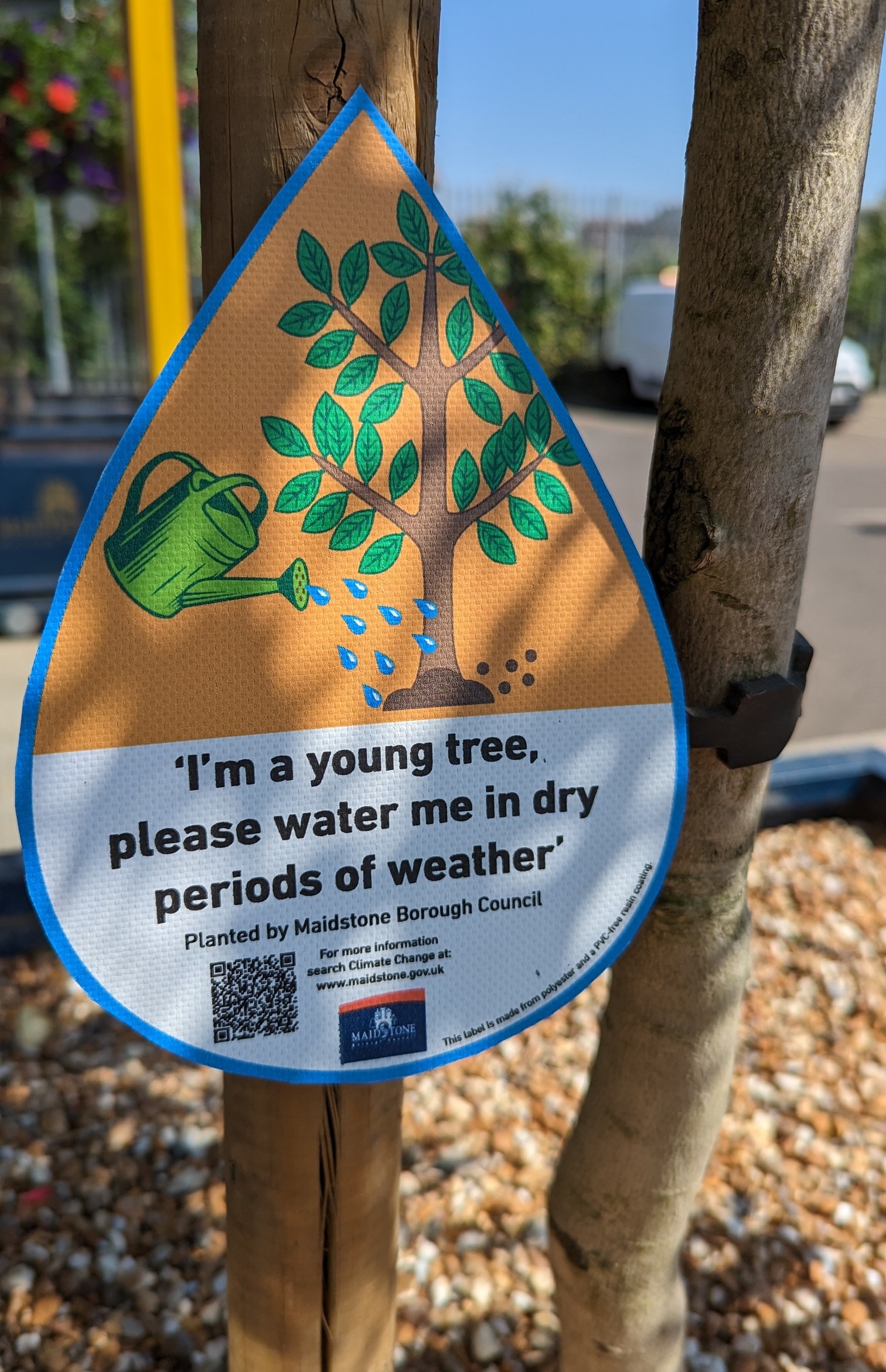 Have you spotted a 'water me' tag on a newly planted tree near you? We are asking residents to support our watering programme and give new trees a drink to help them through the hot summer months. Our new tree tags are durable and long lasting, made from a PVC free material, making them more environmentally friendly.
Newly planted trees need to be watered regularly to ensure they establish and grow successfully, so please feel free to water new trees on your street. Any watering is helpful, but please see below for our top tips:
- It's best to water trees early in the morning or later in the evening.
- One big drink a week is best, but more often is fine during very hot weather.
- Where possible, use collected rainwater or recycled water.
- It's easiest to use a watering can or a water bottle. Ideally, try to give at least 1-2 watering cans per watering – although anything you can manage is great. Please do not carry more water than you can safely carry.
- Only water a tree if you can get to it safely and easily.
- Do not stand in the roadway to water and be aware of other users of the street.
- Be careful of tree thorns and avoid contact with the soil.
Some of the newly planted trees will have a watering pipe. Trees with a watering pipe can have water poured directly into the pipe. This tree watering system helps the tree to get the water in the best way. If the new tree has no watering pipe or if you are finding the watering pipe difficult to use, slowly pour the water into the soil around the base of the trunk. Whether you can water once a week or every day in hot weather, every little helps and you will be making a huge difference!
🐝 Top Tips for a Wildlife Friendly Garden
A biodiverse garden is one that is overflowing with life and has lots of different plant species attracting many forms of wildlife.
No matter the size of your garden, from a window box in a flat to a large country field, this space can be a haven for insects, birds, and other animals, and play an essential role in supporting our rich biodiversity.
Here are some top tips for a wildlife friendly garden:
- Let part of your garden ‘go wild’- When it comes to a wildlife friendly garden, some messiness is good. This area doesn’t have to be neat, trimmed and tidy, as natural debris offers food and a habitat for many species. Overgrown grass, piles of leaves and logs can be a great shelter for animals such as amphibians and hedgehogs. This also encourages insects, which are an essential food source for other animals. Learn how to make a log shelter here.
- Plant Wild Flowers- consider turning an unused corner of your garden into a mini wildflower meadow, or even plant a window box or wildflower container if you’re struggling for space. Native wildflowers are great for wildlife as they flower at the right time of year for our native insects. Learn how to grow a mini meadow here.
- Make a mini pond- water is a great magnet for wildlife. Including a pond, bird bath, or even just a shallow dish of water in your garden will help many creatures thrive, from birds and dragonflies to frogs and newts. Learn how to make a mini pond here.
- Let your grass grow- letting your grass grow not only encourages wildflower growth, but also helps protect the wildlife that calls your garden “home”. Having longer grass allows for a better shelter for creepy crawlies and provides habitats for amphibians and small mammals. Start letting your grass grow by taking part in No Mow May.
- Make your own compost- compost is great for making healthy, nutrient-rich soil, perfect for plants and wildlife. Make your own compost with your garden waste and scraps from the kitchen to benefit your garden and reduce the amount of waste you throw in your bins. Learn how to make your own compost here.
- Create a hedgehog highway- hedgehogs need to be able to roam far and wide in search of food, mates and nesting sites, with the average hedgehog roaming 2km a night. Encourage hedgehogs and other animals to visit your garden by cutting a hole in your fence at ground level, to create easy access. Learn more here.
- Look after your local birds- birds are some of the best-known garden visitors. With natural resources becoming fewer and fewer, offering a helping hand in your garden is a great way to encourage birds to your garden. Nesting boxes, birdbaths and feeders are sure to encourage various birds to return, whilst bug houses and feeders for other bees and beasties will provide a natural food source for visiting birds. Learn how to make your own bird feeder here.
For more things you can do to help wildlife in your garden visit Kent Wildlife Trust's action for wildlife.
🏆Official Green Space Recognition
Get out and about to explore the biodiversity all around you. Maidstone has a wealth of green spaces and gardens just waiting to be explored. Escape the hustle and bustle of the town and enjoy a breath of fresh air in some of the most beautiful parks and gardens in Kent.
In summer 2025 five of our parks in Maidstone were officially recognised as some of the country’s best and were awarded with Green Flags: Mote Park, Clare Park, Teston Bridge Country Park, Brenchley Gardens and Whatman Park (Millennium River Park).
Find out more about Maidstone's parks at Visit Maidstone.
🙋Volunteer with a Local Group
There are many groups in Maidstone that are already helping our local wildlife and enhancing biodiversity across the borough. Why not see what's local to you by visiting our community groups page. Volunteering is a great way to learn new skills, gain knowledge, meet new people and support your community. Local groups are always looking for new volunteers to help support nature thrive in Maidstone.
🌱 Soil Quality Trial
Improving soil quality is central to both ecosystem health and climate adaptation, and Nature‑Based Solutions (NBS) offer practical, long‑term ways to restore degraded soils. Healthy soils support almost every function we rely on in the natural environment — from growing food to storing carbon and filtering water. When soils are eroded, compacted, or depleted, nature struggles to recover. When soils are healthy, ecosystems can rebuild themselves.
Maidstone Borough Council has begun an innovative soil improvement trial designed to test a series of nature‑based interventions that could help restore poor‑quality soils and strengthen the borough’s natural resilience to climate change.
The trial is taking place on a small publicly accessible green space adjacent to Taylor Park and the Sandling Road Allotments. The land, once used as a brickworks disposal site, contains low‑quality soils that provide an ideal baseline for studying how different natural amendments can improve soil health over time.
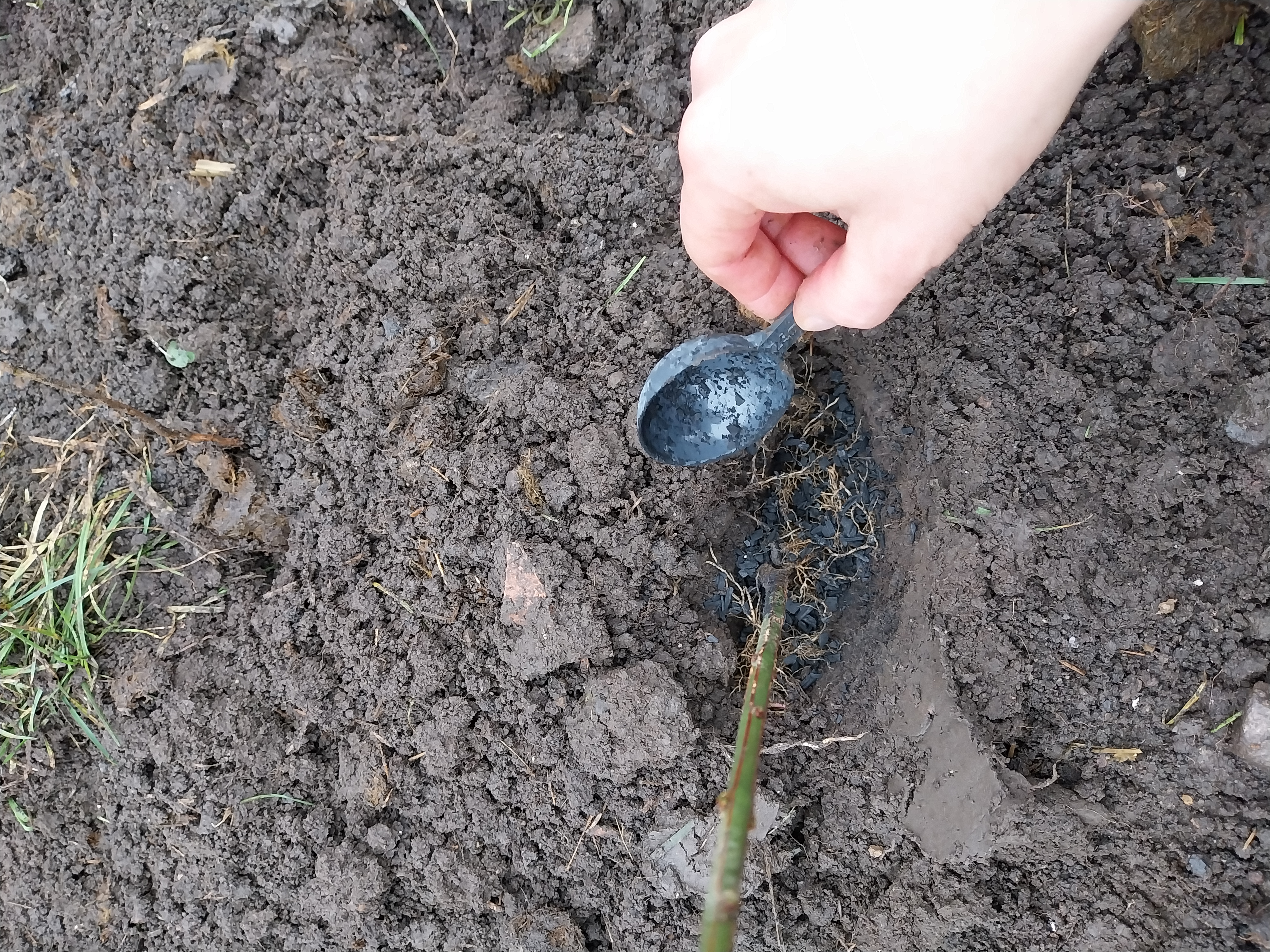
On 4 December 2025, baseline soil samples were collected and a range of interventions were applied. These included combinations of prepared soil, mixed native hedgerow planting, compost, horse manure, mulch, and mycorrhizal spores. A new section of mixed native hedgerow has also been planted along the boundary shared with the allotments. Follow‑up soil sampling will continue throughout 2026 and 2027 to monitor how well the various treatments perform.
This work supports Maidstone Borough Council’s Biodiversity Action Plan and its commitment to the 2024 Nature Recovery Declaration. Two actions in particular are advanced by this project: developing soil restoration approaches for Council‑owned land and exploring opportunities to support symbiotic species, such as beneficial soil fungi, that can enhance nutrient uptake and plant health. Healthy soils underpin a wide range of ecological processes, helping plants thrive, improving water retention, supporting wildlife, and increasing landscape resilience to the impacts of climate change.
The Council hopes the findings will demonstrate that simple, low‑cost, nature‑based methods can significantly improve soil structure and function, and that these approaches can be adopted by communities, landowners, and gardeners across the borough.
🔥 Wildfire Planning
In 2025 we worked with Kent Fire & Rescue to develop our first Wildfire Response Plans for Mote Park and Cobtree Manor Estate. These plans, along with mapping, significant access routes, key features etc have been produced and provided to Kent Fire & Rescue. We now have fire beaters at both Mote Park and Cobtree, and within our Management Plans we regularly assess our practices and log incidents to inform, for example, adapting our fire breaks to ensure safe distances between potential fuel sources.
🌊 Natural Flood Management and River Restoration
Maidstone Borough Council is supporting a two-year, farmer-led project to improve rivers, wetlands and wildlife habitats across the Lower Beult catchment. Delivered by Kent Wildlife Trust in partnership with local farmers and landowners, the project will help create and strengthen farmer clusters that work together to deliver environmental improvements at a landscape scale.
Natural Flood Management (NFM) actions will include restoring wetlands and river corridors, improving habitats alongside watercourses, and encouraging land management practices that help slow the flow of water through the landscape. These measures can help reduce flood risk, improve water quality, increase biodiversity and make the countryside more resilient to climate change.
The project builds on the successful Upper Beult approach, supporting local farmers to share knowledge, access expert advice and attract additional funding to deliver long-term benefits for nature, rivers and rural communities.
In addition, Maidstone Borough Council are also creating and enhancing wetland habitats on Council owned land and parks.